
Not long ago, most organizations outside of financial services and healthcare could treat penetration testing as optional. That has changed.
The forces pushing organizations toward pen testing in 2026 are converging from multiple directions at once. Cyber insurance carriers have tightened underwriting requirements significantly since 2024. Policies above certain coverage thresholds now require evidence of annual penetration testing, and carriers are getting more specific about what those reports need to contain. A vulnerability scan no longer satisfies the requirement. Insurers want proof that a qualified human tested your defenses, not just that an automated tool ran against your systems.
Regulatory mandates are expanding across industries. PCI DSS requires annual penetration testing and has for years. Financial institutions under NYDFS cybersecurity regulation face an annual pen testing requirement. Proposed changes to the HIPAA Security Rule — if finalized as expected in mid-2026 — would mandate annual penetration testing for all covered entities and business associates for the first time. The pattern is consistent: regulated industries are treating pen testing as mandatory rather than optional, and the trend is moving in one direction.
Enterprise customers are asking harder questions too. Security questionnaires now routinely include pen testing evidence requests. RFP requirements ask when you last tested and who performed it. For a growing number of organizations, the pen test report is no longer just an internal security document — it is a sales asset that determines whether you qualify for the next round of procurement review.
The question for most organizations is no longer whether to get a pen test. It is how to choose a provider who delivers something worth paying for.
What Is a Pen Test?
The most common mistake buyers make is confusing penetration testing with vulnerability scanning. They are related but different services, and confusing them leads to buying the wrong thing.
A vulnerability scan is automated. It runs software tools against your systems to identify known weaknesses by comparing your environment against databases of common vulnerabilities. Scanning is designed for breadth and frequency. It covers a lot of ground quickly and should be run regularly. It is a necessary part of any security program.
A penetration test is human-led. A qualified tester actively attempts to exploit vulnerabilities, chains multiple weaknesses together to simulate realistic attack paths, and identifies issues that automated scanning cannot find: configuration errors, logic flaws, operational security gaps, and weaknesses in how your people respond to social engineering. A pen test answers the question: can someone actually break in, and how far can they get?
Most mature security programs use both. Scanning gives you continuous visibility across your attack surface. Pen testing gives you periodic, in-depth validation that your defenses actually hold up under active attack conditions. They are complementary, not interchangeable.
Here is a practical signal: if a provider is quoting a “penetration test” for $4,000 to $5,000 or less, you are almost certainly looking at an automated scan repackaged with a pen test label. Genuine human-led testing requires skilled professionals spending days inside your environment. That level of expertise has a floor price, and anything significantly below it should prompt questions about what is actually being delivered.
What Should the Report Tell You?
A pen test report that sits in a shared drive because nobody can act on it is a waste of money. The report is the deliverable. If it does not give your team clear direction, the engagement failed regardless of how skilled the testers were.
A useful pen test report contains five things:
- Findings rated by actual risk — not just the raw severity of the vulnerability in isolation, but the risk it poses in your specific environment. A cross-site scripting flaw in an internal tool used by three people is not the same risk as one in a patient-facing portal used by thousands.
- Specific remediation guidance for each finding. Not “fix this vulnerability” but actionable steps your team or IT provider can execute.
- Compliance framework mapping. If you are subject to PCI DSS, SOC 2, ISO 27001, or NIST requirements, your pen test findings should map directly to the controls those frameworks care about. That mapping turns the pen test report into audit documentation, not just a security finding.
- An executive summary that a non-technical leader can read and act on. The CFO approving next year’s security budget does not need to understand CVSS scores. They need to know: what is the overall risk picture, what are the highest-priority items, and what does remediation require?
- Clear documentation of scope, methodology, and tools used. This matters when your report needs to satisfy an auditor, an insurance underwriter, or an enterprise customer’s procurement review.
A recent pen test of a multi-location commercial truck dealership’s PCI-relevant infrastructure produced exactly one low-risk finding across six external IPs and a full internal card reader environment. The value was not in the finding itself. It was in the documented, compliance-mapped proof that the organization’s security controls held up under independent testing. That documentation is now part of their PCI compliance evidence package.
If a provider cannot show you a sample report before you engage, that tells you something. Ask to see one. Compare it against these five criteria. The quality of the report is one of the most reliable indicators of the quality of the engagement.
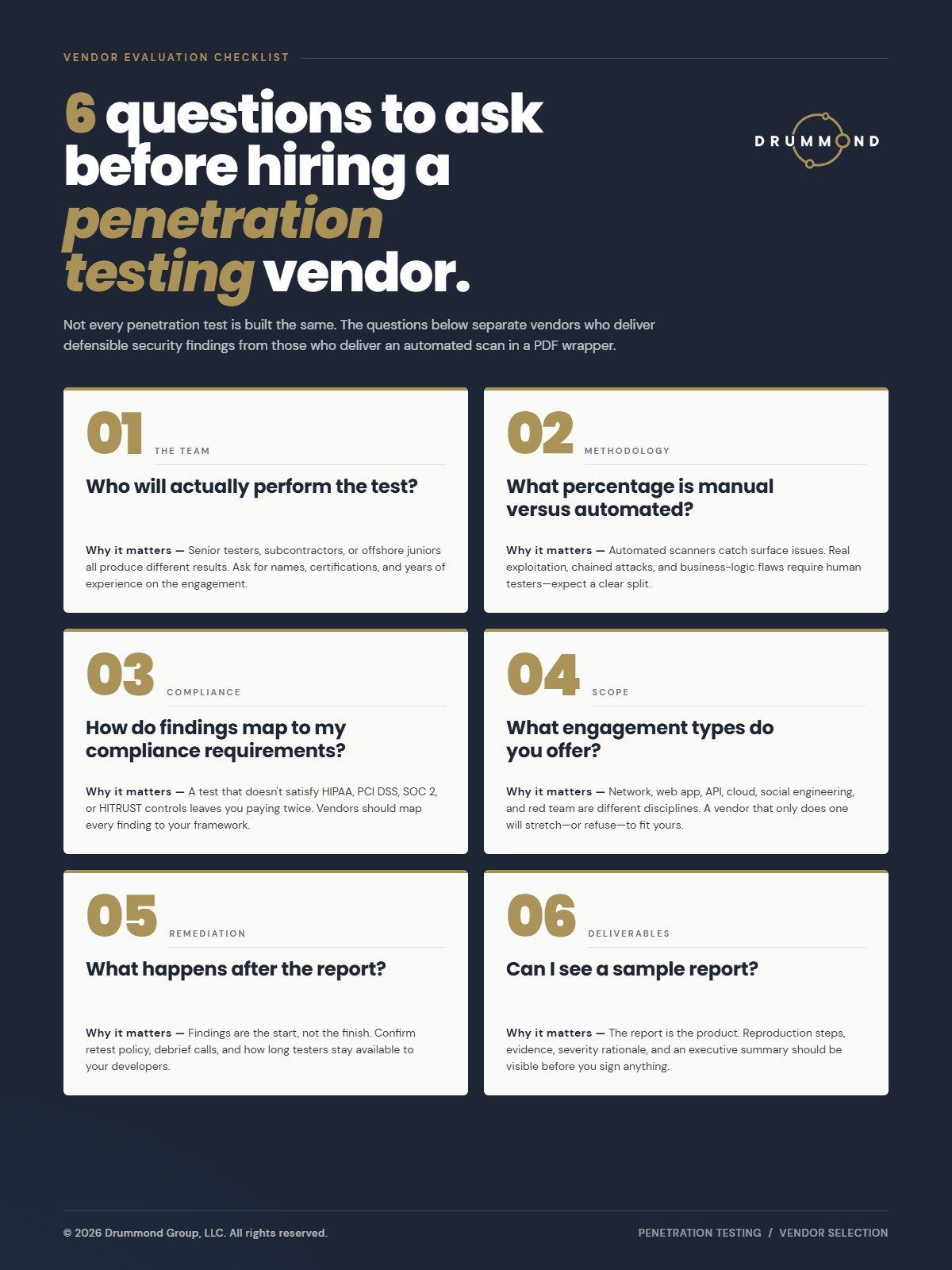
Six Questions Worth Asking
Not every organization has a security team to evaluate pen testing proposals. These six questions are designed to give you a reliable signal about what you are actually buying, even if security is not your primary job.
1. Who will actually perform the test?
This is the single most important question, and the one most often left unasked. Many firms sell the engagement based on their most senior expert, then assign a junior tester to do the actual work. A strong answer names the lead tester, describes their experience, and commits to senior-level involvement throughout the engagement. A weak answer deflects to “our team” without identifying who will be on your engagement or what their credentials are.
2. What percentage of the engagement is manual versus automated?
Every pen test uses some automation for initial reconnaissance and scanning. The question is what happens after the automated tools run. A provider that relies heavily on tool output without manual validation, creative exploitation, and contextual analysis is delivering a dressed-up vulnerability scan. The findings that matter most (chained attack paths, logic flaws, social engineering susceptibility) do not come from automated tools.
3. How do your findings map to my compliance requirements?
If you operate in a regulated industry or carry cyber insurance, your pen test needs to do double duty: test your security and produce documentation your auditor or underwriter can use. A strong answer describes how the report is structured to serve compliance documentation requirements and names the specific frameworks the provider has experience reporting against. A weak answer treats compliance mapping as an afterthought or charges extra for it.
4. What engagement types do you offer?
Penetration testing is not one thing. It spans network testing, web application testing, physical security testing, social engineering assessments, and adversarial exercises like Red Team or Purple Team engagements. A provider limited to one or two types may not be able to cover the attack surfaces that matter most to you.
A recent engagement with a multi-state healthcare organization involved three separate test types against the same environment. The web application pen test found stored cross-site scripting flaws that allowed low-privileged users to escalate access, plus server information disclosure leaking internal infrastructure details. The social engineering campaign captured employee credentials across three phishing waves. The code review found hardcoded credentials in the repository and SQL injection vulnerabilities. Each test uncovered a different category of risk. No single engagement type would have revealed the full picture.
Ask about the range of engagement types available and whether the provider uses White Box, Black Box, and Grey Box approaches. The right approach depends on your goals: are you testing whether an outsider can get in, or whether someone already inside can escalate their access?
5. What happens after the report?
This is where many engagements fall apart. The report arrives, and your team does not know where to start or whether the fixes they implement actually resolve the issues.
Ask whether the provider offers remediation verification, and specifically, whether the same firm that identified the vulnerabilities will verify that your fixes worked. This is where the business model matters. If the provider that tested your systems also sells remediation services, they have a financial incentive in what they find and what they recommend you buy. A provider that identifies vulnerabilities, delivers actionable remediation guidance, and then verifies your fixes in a separate engagement keeps testing and remediation independent. That separation is more credible, not less.
6. Can I see a sample report?
A provider confident in the quality of their deliverables will share a redacted sample. Compare it against the five report criteria described earlier. If the sample is mostly automated scan output with a cover page, that is what you will receive. If it contains risk-rated findings with specific remediation steps, compliance mapping, and a clear executive summary, you are looking at a different caliber of engagement.
How Much Should a Pen Test Cost?
Pricing is one of the biggest sources of confusion around penetration testing. Quotes for what appears to be the same service can range from $3,000 to $50,000 or more. The variation is not random; it reflects real differences in what is being delivered.
For a focused external network pen test covering a small number of IP addresses, expect a range of $5,000 to $15,000. A web application pen test typically runs $5,000 to $25,000 depending on the complexity of the application and how much authentication and business logic testing is required. Internal network testing ranges from $7,000 to $35,000 depending on environment size. A comprehensive engagement combining external, internal, web application, and social engineering testing for a mid-sized organization can reach $15,000 to $50,000 or more.
The factors that drive cost are scope (number of IPs, applications, and environments), complexity (cloud, hybrid, or on-premise; legacy versus modern infrastructure), testing approach (Black Box testing requires more reconnaissance time; White Box testing requires more depth), compliance documentation requirements, and the seniority of the testing team.
The floor matters. If a quote comes in under $4,000 to $5,000 for what is described as a penetration test, ask what percentage of the work involves manual expert testing versus automated scanning. Providers at that price point are typically delivering automated vulnerability assessments, which have value but are not penetration tests.
If you want to estimate scope and cost before engaging a provider, the Penetration Testing Calculator at drummondgroup.com can help you define parameters and set budget expectations before the first conversation.
When and How Often to Test
Annual penetration testing is the minimum for most organizations. PCI DSS requires it explicitly. Cyber insurance carriers expect it at renewal. SOC 2 and ISO 27001 auditors look for it in the evidence package. In healthcare, proposed HIPAA Security Rule changes would mandate it for all covered entities if finalized as expected in mid-2026.
Beyond the annual cycle, certain events should trigger additional testing: a major infrastructure change such as a cloud migration or new application deployment, a merger or acquisition introducing unfamiliar systems, a security incident raising questions about current exposure, or a significant change to your team or security tools.
New technology deployments are worth specific attention. An AI-powered ecommerce platform recently engaged a pen testing firm after deploying an AI chatbot feature. The test covered not just traditional web application vulnerabilities but AI-specific threats: prompt injection, jailbreak attempts, and data exfiltration through the language model. The result was zero vulnerabilities identified. That clean result was not a wasted engagement; it was documented, independent proof that the security investment worked, and that documentation carries weight with customers, auditors, and insurers.
The annual pen test is not just about finding new vulnerabilities. It validates whether last year’s remediation actually worked. It establishes a documented baseline showing your security program is maturing over time. And it produces fresh evidence for the conversations that matter: insurance renewals, customer due diligence, and regulatory examinations.
What to Do Next
You now have the evaluation criteria, the questions, and the pricing context to make a sound decision about which penetration testing provider is right for your organization.
If you are still defining scope and budget, Drummond’s Penetration Testing Calculator is a practical starting point. It helps you set parameters before you talk to any provider, so your first conversation is about specifics rather than guesswork.
If you are ready to talk through what your specific situation looks like: which engagement types fit your environment, how findings should map to your compliance requirements, and what a realistic timeline and budget look like, schedule a FREE cybersecurity consultation with Drummond’s team.
No pitch deck. A real conversation about where you are and what your options look like.